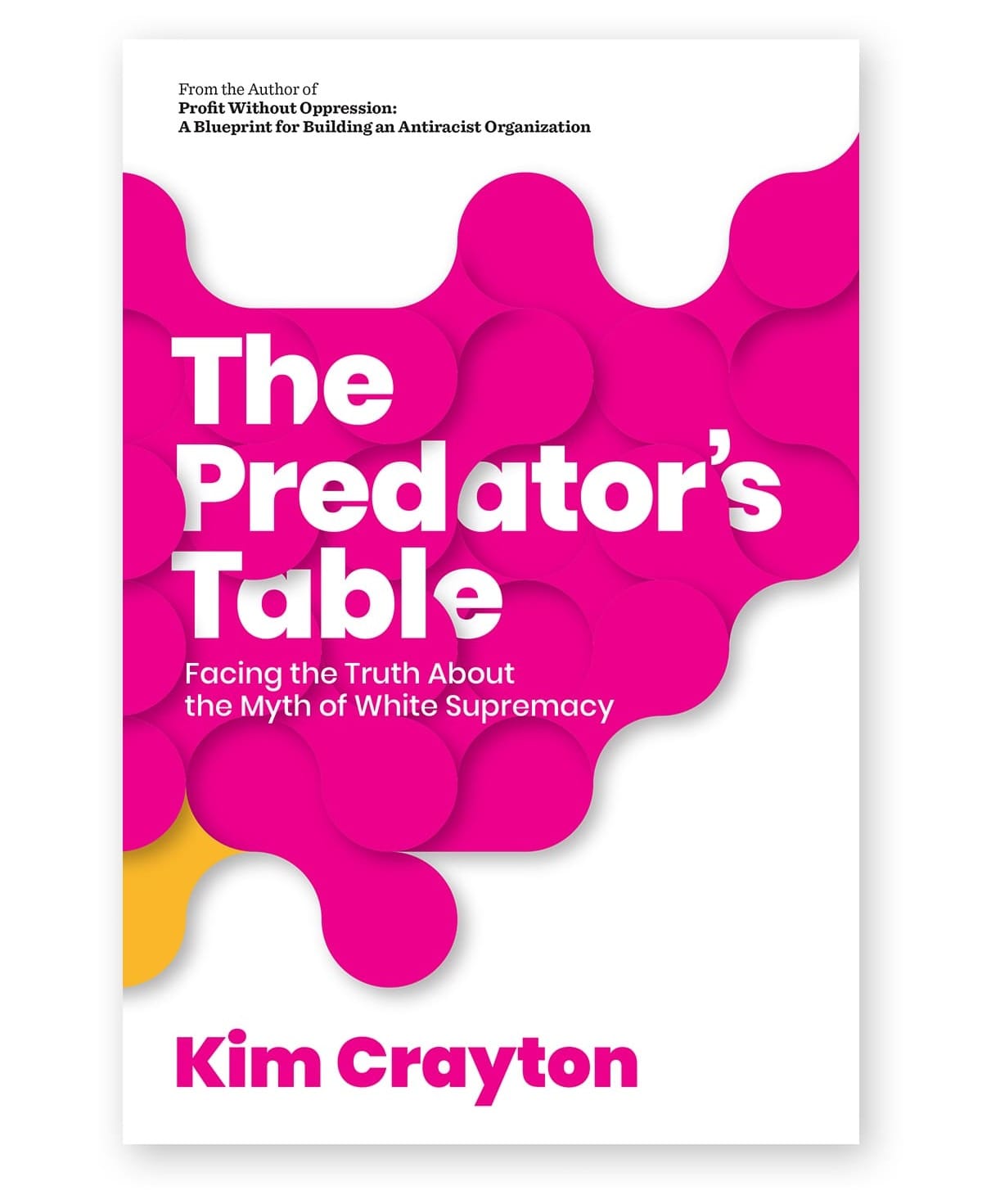
The Book
Volume 1 of the Life Beyond the Supremacy Myth field guide series is being written this season, in public, in real time.
Every newsletter issue, every live event, every piece of content published between May 27 and August 1, 2026 is documentation of this book being written. You are not watching someone promote a product. You are watching the work being built.
The book is the 100-level course that makes everything else in the ecosystem make sense. If you have ever asked why: why this work, why this structure, why now, this is where the answer lives.
Volume 1 publishes late Summer 2026.
Writing in Public
This is a journal about the writing process. Not the finished version. Not the draft. The thinking behind it: what it felt like to write a particular section, what surprised, what resisted, what arrived unexpectedly, why a decision got made. No schedule. No series. The draft stays private. What goes public is the thinking.
May 2, 2026
I met with two beta readers today for Chapters 1-3. It turned out to be exactly right. A larger group would have been hectic. This was a conversation.
What I needed to know was whether the work lands for people who already know the framework before I send it to people who do not. Both of them confirmed it does. But more than that, the session produced two things I had not said out loud before.
The first came from one of the readers talking about evangelical Christianity and how believing in yourself is frowned upon. You put your trust in the Lord, not yourself. You cannot depend on your own judgment. There is always a higher authority that knows better. I wrote it down as he was speaking: believing in yourself is discouraged, which is set up for manipulation, which is set up for coercion, which is set up for exploitation, which is set up for discrimination. That chain is the whole argument of the book in one sequence. I had never said it that cleanly before. It came from listening to someone else name their own experience.
The second came later, in the Chapter 3 discussion about childhood indoctrination and how we get compliance through fear: we learn to live in society out of fear and not joy. Both of them went quiet for a second. That is how I know it landed somewhere real. It named something that does not get named.
One reader pushed back on Chapter 2. Not on the argument, on the clarity. The Predator's Table is not coming through on the page the way it comes through when I explain it. He was right, and he said it directly, which six months ago he would not have done. That is its own kind of proof. The work is building something in the people doing it. The third draft will address what the page is not yet doing. A sentence or two. That is all it needs.
What I gained from this session is not a list of revisions. It is confirmation that the argument is real and the language is doing what I built it to do. The rest is craft.
April 30, 2026
A beta reader sent a voice message today. She has read three chapters.
She started her antiracism journey with what she called the White Lady books. She course-corrected. She found her way to bell hooks. All About Love is her favorite book. She is not a beginner. She has been doing this work seriously, with real discernment about what is worth her time, for long enough to know the difference.
After three chapters she said: you are calling our hearts with this book. Not our minds. Our hearts. And when it lands there, she said, we know we can do better. We know.
She corrected herself mid-sentence. Started with I think the world is ready. Stopped. Said: I know the world is ready.
She said she is learning more in three chapters than she has ever learned. She said she can tell I am writing this with ease. That it is exceptional.
I have been sitting with the question of whether this moment will hold since I sent the draft out. Whether the pain is deep enough to make people stay. This reader is not answering that question from a place of hope. She is answering it from a place of knowing. The distinction between those two things is the entire argument of Chapter 12.
The ease she named, I felt that while writing it. That is the sovereignty made visible from the outside. Two people named it today without knowing each other or talking to each other. The advising client named it. She named it. The work is already doing what I built it to do.
I was in an advising session today and said two things I have not said before.
The first was in response to a client's frustration about their current products and services feeling like a ceiling. I said: what we have is not a great indicator of what's possible. The moment it came out I recognized it as the table named inside an organizational context. The myth does not only determine who gets resources. It determines what gets envisioned. Organizations use what currently exists as proof of their limits rather than as evidence of where they started. That is the predator's table operating inside strategy. And I had the language for it in real time because the book gave it to me.
The second was in response to the same client sharing the particular frustration that comes from being exposed to the work and not being able to unsee what they now see. I said: you know too much to go back but you don't know enough to go forward. That is the shed named precisely, from outside of it, in the middle of a conversation. The client recognized it immediately. I recognized it as the condition Chapter 11 documents. And I had the language for it because the book gave it to me.
At some point today I also just said "that's the table" in response to something the client described. Three words. No explanation needed. The client understood immediately. What used to require a long walk through the framework now takes three words because the framework exists as a named, shared reference. The book made that possible. I felt that today in a way that confirmed something I have been sitting with since sending the second draft to beta readers: the work is already working. The language is already doing what I built it to do. That is not a future state. It is already here.
April 29, 2026
A post I wrote today about the predator's table and patriarchy reached someone entirely outside my immediate community. They found it through a share, left a comment naming the predator's table concept unprompted, and the post brought in new followers.
What struck me is not the reach. It is what the response confirmed. This person had no prior relationship with the ecosystem, no onboarding, no context beyond what the post itself provided. The concept landed anyway. They recognized it, named it accurately, and engaged with it as if it made sense of something they had already been thinking about.
That is the Rings of Care functioning exactly as designed. Ring 6 -- someone with no shared affinity, no prior relationship, reached through someone else's ring work carrying the content outward. The work traveled without me. The concept transferred without explanation.
This is social proof that the book's central argument is legible beyond the people who already know the work. The predator's table is not insider language. It names something people already feel but have not had words for. That is what I needed to know before August 1.
April 28, 2026
I just shared the second draft of The Predator's Table with a small group of white folx I know are doing the work.
And I am sitting with something I do not know how to fully name yet.
I have been doing this work most of my adult life. I have watched white folx show up after every visible crisis, commit to change, and then quietly return to comfort when the conditions stopped demanding otherwise. After George Floyd. After every moment that looked like a turning point. The commitment never lasted. The pain was never quite deep enough to make them stay.
I wrote Profit Without Oppression for that moment. Organizational and political leaders were just beginning to reckon with what equity actually required. And then they walked away. The window closed before the work could take hold.
The Predator's Table is written for this moment. And the question I cannot answer from here is the same one: is today's climate finally producing enough pain in white folx that they will do more than show up? That they will stay? That this time the commitment will outlast the comfort?
What I have created is so precisely aligned with what my audience needs that it almost does not feel real. Not because I doubt the work. Because it is that good. For the first time I am not adding a caveat to that sentence. I know what I built. I know who it is for. I know what it asks of them.
The vulnerability is not about the writing. It is about that question. I do not know if this moment will hold. I only know the book is ready.
April 26, 2026
I thought the second draft was done yesterday. Today revealed that it was structurally complete but not yet whole.
The governing concept, the Predator's Table, was fully present in the Introduction and in Chapters 2 and 3. And then it largely disappeared for the next ten chapters. Not because the content was wrong. Because I had been so focused on building each chapter's individual argument that I lost track of the thread that holds the whole thing together. The threading pass today was not about adding new material. It was about making visible what was already implied but never named. One sentence in most chapters. A short paragraph in Chapter 7. That was all it took. Which tells me the arguments were right. They just needed to be connected back to the frame.
What changed Chapter 13 was the distinction between two dimensions of the concept that I had been treating as one. The table as the mechanism where no one is safe, that was already in the book. The table as a relationship structure, where the predator's most effective tool is the hierarchy installed among prey, where some prey endure harm in exchange for the promise that other prey will always have it worse. That was named in conversation today and it reframed the entire close. The agreement. The moment the agreement breaks. Prey is prey. That is the sentence the book had been building toward and had not yet said out loud. Once it was said, Chapter 13 wrote itself.
The beta reader course surprised me. I had been thinking about it as something to design and build. It is not. It is the book doing what it was already designed to do, delivered to people who are ready to be inside it. The prompts are already written. The facilitation structure is already confirmed. The only new thing is the container, and even that took less than a day to build. I kept waiting for the complicated part. There was no complicated part. That is what it feels like when the foundation is actually there.
The decision to sequence qualitative feedback before quantitative was not obvious to me at first. The rubric felt like the more rigorous tool. But what I actually need to know before the manuscript locks is not whether the sentences are clean. It is whether the book works on the people it was written for. Whether the Spot the Pattern prompt surfaces something real. Whether the Name the Cost question lands in the body or stays in the head. Whether someone who has not been inside this ecosystem for years can follow the argument from the beginning and arrive at Chapter 13 changed in some way that is legible to them. The rubric cannot tell me that. People in a room can.
April 25, 2026
The second draft is done. All thirteen chapters. I am sitting with that for a moment before I do anything else.
What I did not expect was how much the process of scoping each chapter before writing it would change what the writing was. In previous sessions the draft went straight from source material to text and the seams showed. Today the scope became the argument, and once the argument was named, the chapter knew what it was doing before a single sentence got written. That is not a writing trick. It is the same thing this book keeps saying: you cannot build from the outside in. The foundation has to exist first.
Chapter 7 is the one I want to hold onto. It took three attempts and two full structural rebuilds before it worked. The first version was a continuous argument. The second tried to be a continuous argument with better transitions. Neither worked because I was forcing the wrong form onto the right content. The content of Chapter 7 is that the harm is everywhere, random, and constant. You cannot make that argument with a tidy through-line. The through-line would contradict the claim. The solution arrived in my own comment back to the process, not in the drafting, and that is the thing worth naming: I already knew what the chapter needed. I was looking for it in the wrong direction.
What the minefield frame did was give the chapter permission to be what it actually is. Not a list. Not a demonstration pretending to be an argument. A walk through the field. The form had to serve the content rather than fight it. Once that clicked, everything else followed. That is what I have been trying to get right across this entire draft, and Chapter 7 is where it became most visible.
The other thing that keeps coming back to me is the trust versus loyalty material. It started as the second requirement in Chapter 9. I caught it in review: the two requirements are a strong why and the practiced capacity to ask what am I missing. Trust versus loyalty did not disappear from the book. It found its home in Chapter 5, where the psychological wage lives, because the psychological wage is fundamentally a loyalty arrangement. White folx traded real community and genuine trust for the performance of loyalty to whiteness. The concept was right. The placement was wrong. The book sorted itself out.
I finished today knowing the second draft is structurally sound in a way the first draft was not. Not because it is more polished. Because it knows what each chapter is for and what it is not for. That clarity came from being willing to slow down, scope before drafting, and rebuild when the form was not serving the argument, even when that meant starting over. Three times, in Chapter 7's case.
The work is the life. I felt that today in a way that was not metaphorical.
April 24, 2026
Something shifted today that I want to name before I lose it.
Writing this book has been cathartic in a way I did not anticipate and cannot fully explain. Not the therapeutic kind of cathartic, not processing pain for the sake of processing it. The kind that comes from full presence inside creation. From being so completely inside the work that the work and the person doing it stop feeling like separate things.
Creatives describe this. I always understood it intellectually. Today I felt it.
What I am experiencing is internal validation. Not the kind that requires an audience, a response, a metric, or a reaction. The kind that simply is. The pre-myth self operating without a scoreboard. Making something because the making is the point.
This is what I want the reader to feel by the time they reach the end of this book. Not inspired. Not motivated. Not grateful for the permission someone else gave them. Present. Inside their own life in a way the myth spent years making impossible. Returned to the self that was always there, underneath everything the myth installed, doing the thing that is theirs to do without needing anyone to confirm it first.
The book is working. I can feel it from the inside. That is the only proof that has ever mattered.
April 23, 2026
Writing the second draft of Chapter 3 today meant going back into something I lived for decades before I had language for it.
The passage about being punished for clarity, about learning to distrust your own accuracy because the rooms you were right in made you pay for it alone, that was not hard to write because it is distant. It was hard to write because it is still true. Not for me. For so many people I watch navigating the same conditions right now without the frame that would let them see what is actually happening.
What the myth does to the people it cannot silence is precise and predictable. It turns the cost of their truth-telling back on them as self-doubt. It makes the damage look like a personal failing. And the people most capable of naming what is wrong spend their energy questioning whether they are capable of seeing clearly at all. I lived inside that for years. The instincts were accurate. The perceptions were correct. The rooms were not ready. And I absorbed that cost alone, every time, without understanding that the cost was by design.
What changed was not the world. The rooms are still the same. The systems, institutions, and policies that made those rooms what they are have not been dismantled. What changed was where the mirror was pointed. Turning it away from myself and toward the systems, institutions, and policies that built the conditions, that was the shift. Not a spiritual practice. Not a mindset change. A structural reframe that made the damage legible as damage instead of as evidence of something wrong with me.
What I see now in so many people, white folx especially, is that same mirror still pointed inward. Still asking what is wrong with them. Still looking for the personal fix to an intentional and strategic condition. The suffering is real. The direction of the inquiry is wrong. And the myth depends on that misdirection to keep reproducing itself.
That is what this chapter is about. And writing it today, I felt the distance between where I was and where I am now not as pride but as evidence. The work is real. The shift is possible. And it did not require the world to change first.
April 22, 2026
Two things arrived today that belong together.
Someone responded to part 3 of my current three-part Joy series and brought something back to the work that I want to hold onto. They had been thinking about what I said about joy, held it, and started noticing how some very online lefties are committed to "everything is terrible" as a posture. They named their own complicity in it. And then said this: it is liberating not to be afraid of feeling and showing joy.
That landed. Because what they described, suffering as political seriousness, joy treated as evidence that you are not paying attention, is the deferral economy wearing progressive language. The same logic. A different justification. And the fact that they arrived at that observation themselves, from sitting with the work, is the framework doing exactly what it is designed to do.
The second thing is connected and it has been with me since this morning. While working on content for the second draft, I started processing my reasons for pursuing a doctorate, my desire to democratize business school education via the Thoth Institute, and the paid clients who were already proof that I knew my work. What surfaced was something I had not fully named before: the myth had installed a definition of success long before I started building anything. A credential. A title. An institution's permission to say you know what you know. That definition was already in place, which meant everything I was actually building, the clients, the work, the clarity, the frameworks that were already forming, could not register as success no matter how real it was. The ruler was set before I picked up the tools.
The clearest example: I wrote Profit Without Oppression, an economic framework, and was publicly known as the antiracist economist. And still could not claim the title economist comfortably because I had not studied it formally or held a position with that name attached. For three years during the shed period, while I was not promoting the book, I stopped using the title entirely. The work existed. The framework was published. The title had already been used publicly. And the myth still had me gatekeeping myself from my own label. The same instinct that produced the Thoth Institute, the desire to make knowledge accessible without the gatekeeping, was being turned inward. I was doing to myself what the systems had done to everyone else.
What I needed to understand is that the success was real. The ruler was wrong.
That is the same mechanism as the joy series response. Joy misnamed as irresponsibility. A life's work misnamed as failure. Both are about the myth installing the wrong metrics so thoroughly that what is actually working gets called something else. The excavation is not just about finding the pre-myth self. It is about finding the pre-myth definitions. What success actually looks like when the ruler is yours. What joy actually feels like when it does not have to justify itself.
That is what this book is doing. And today was proof that it is already working.
April 21, 2026
Today's Spanish lesson became a writing session I did not plan for.
My teacher and I got into the table. In the book, the Predator's Table is the organizing mechanism of the myth: the structure that determines who gets access, who produces value for others to extract, and who holds the seat. It is not a room you walk into. It is the condition of the world you were born into. We were not talking about the book. We were just talking. And she arrived at the same architecture from a completely different direction, in her own language: how the pursuit of the table becomes the only organizing principle of a life, how everything, success, marriage, children, belonging, gets collapsed into one question: do I have a seat? That confirmed something I had been circling for weeks. The table needs its own full explanation before the reader can use it. The Introduction names it. Chapter 2 has to build it. You cannot hand someone the central argument of a book as a reference before walking them through what it actually is and how it functions. That is the work Chapter 2 is now doing differently.
The other thing that happened today was reading the responses to this week's posts on joy. People wrote about feeling something they could not name for years. About knowing something was wrong with the performance they were being asked to give but not having a word for what was being taken from them. One person said they were not thinking big enough. Another said they did not know to call it whiteness until now.
That is the same thing as the table, approached from a different angle. The framework is not introducing a new idea. It is naming something that was already felt. The pre-myth self already knows. It registered the cost before there was language for what was being extracted. The joy posts landed the way they did not because the argument was new but because people already had the feeling and finally had somewhere to put it. The table conversation with my teacher landed the same way. She knew the architecture before she had the word for it.
This is what the book is actually doing. Not teaching something foreign. Handing back something that was already there. The reader is not missing information. They are missing the name for what they already know. That is what remember means. Not going back to childhood. Not returning to something lost. Returning to the self that was whole before the myth covered it over. The work is excavation, not construction. And the proof that it is working is in the responses: people feel it before they can say it. The saying is just the next step.
April 20, 2026 — Opening passage, Introduction
"You are already at the table.
You did not choose it. You were born into a world where the seat had already been assigned, the rules already written, the cost of belonging already decided before you were old enough to grow up or gain your consent. And because the table was always there, you learned to want it. You learned to work for it. You learned, eventually, to defend it.
That wanting is where this begins."